Contextual projection on objects, tables and workstations


The technology
behind CARDS
CARDS combines spatial projection, computer vision and artificial intelligence to turn a table, workstation or physical space into an interactive interface.
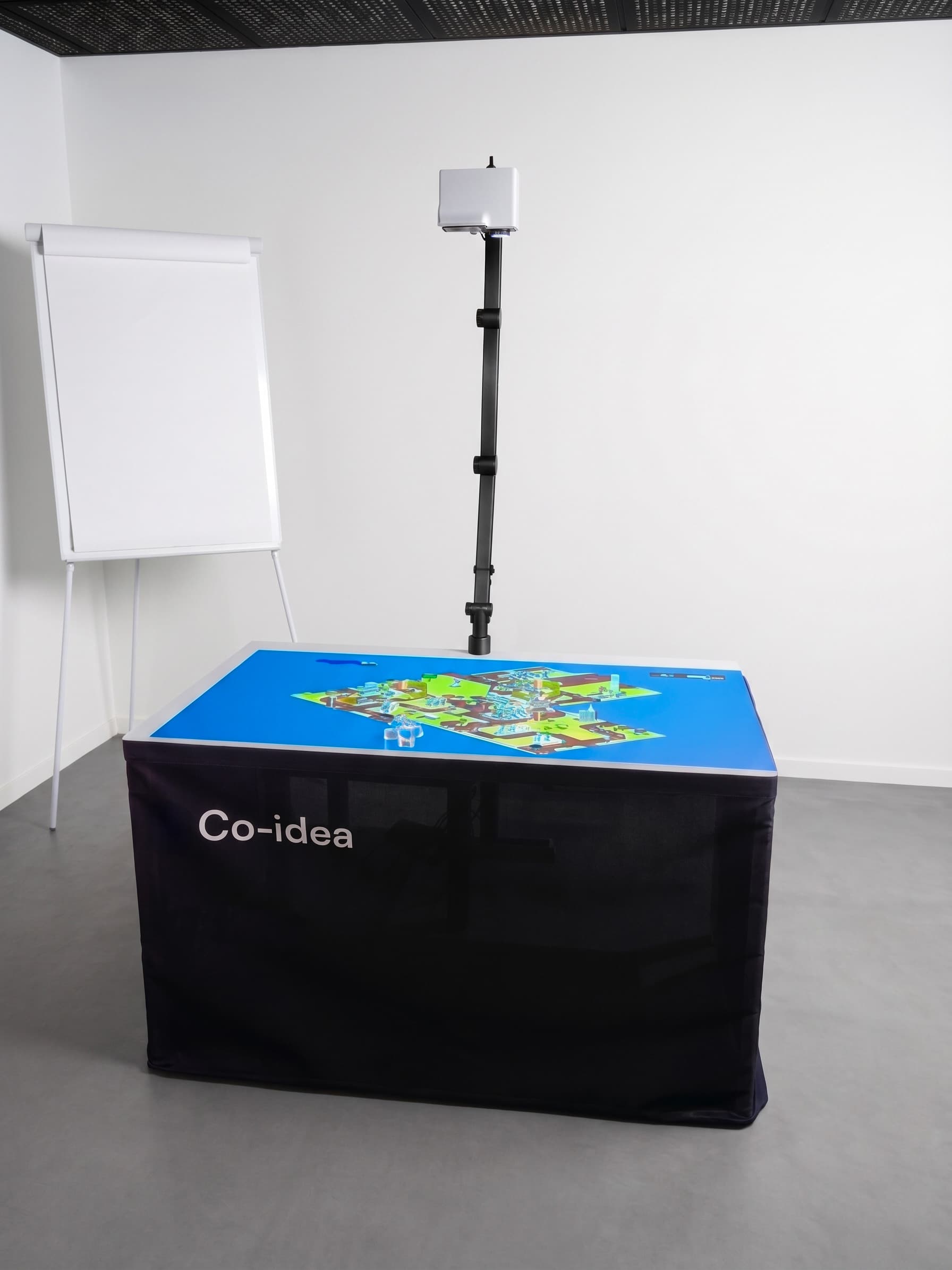
Architecture
A synchronized physical and digital
loop
The system calibrates camera, projector, content and interactions to display the right information in the right place, then measure what happens in the real workspace.
Camera-projector calibration adaptable to real sites
Object, gesture, position and area detection
Content managed from the web platform
Contextual projection on objects, tables and workstations
Camera-projector calibration adaptable to real sites
Object, gesture, position and area detection
Content managed from the web platform
Three building blocks
working together
CARDS gets its value from the alignment between hardware, software and operational intelligence. Each layer remains easy to deploy, while the complete system becomes an augmented workspace.
Spatial projection
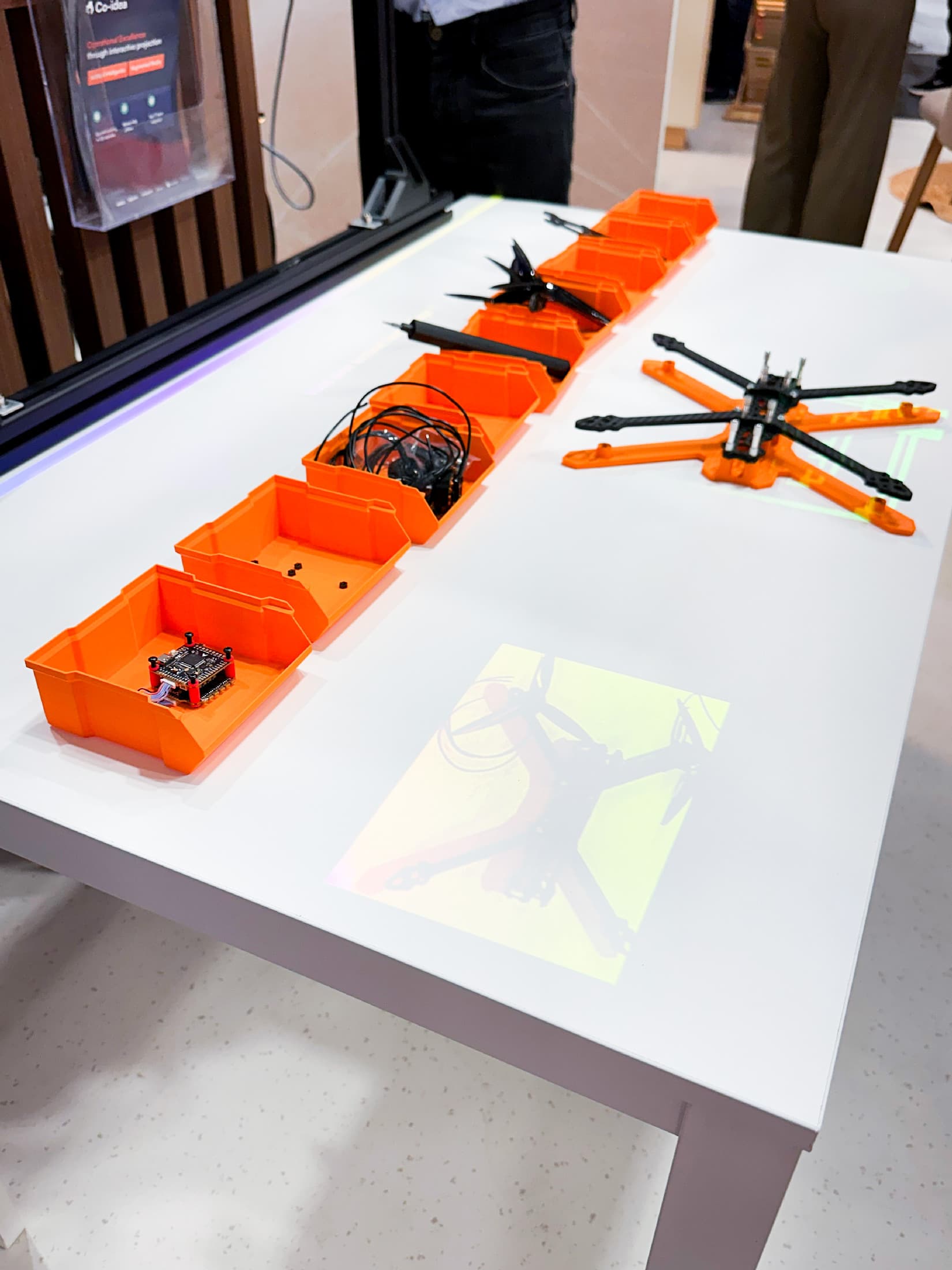
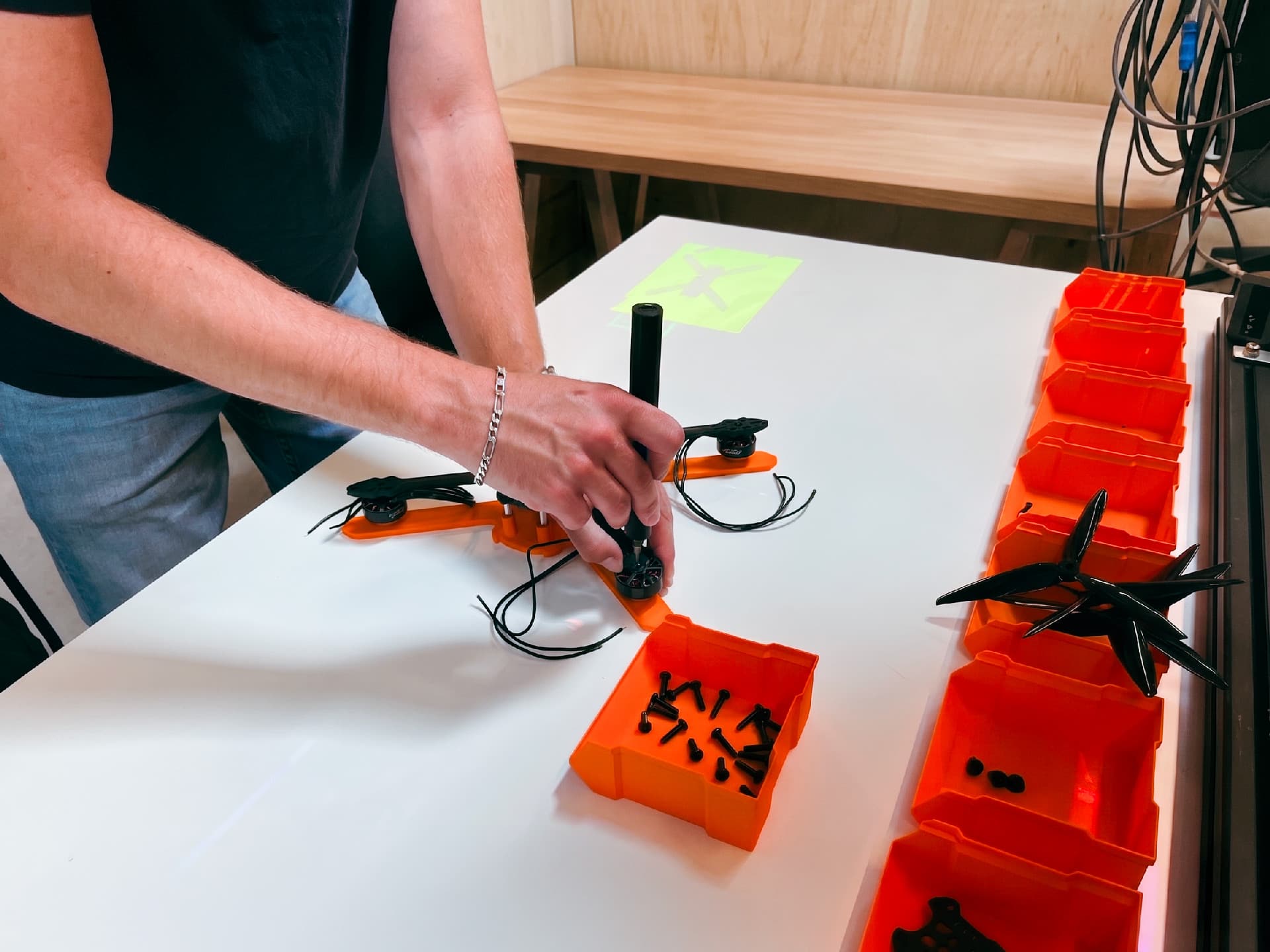
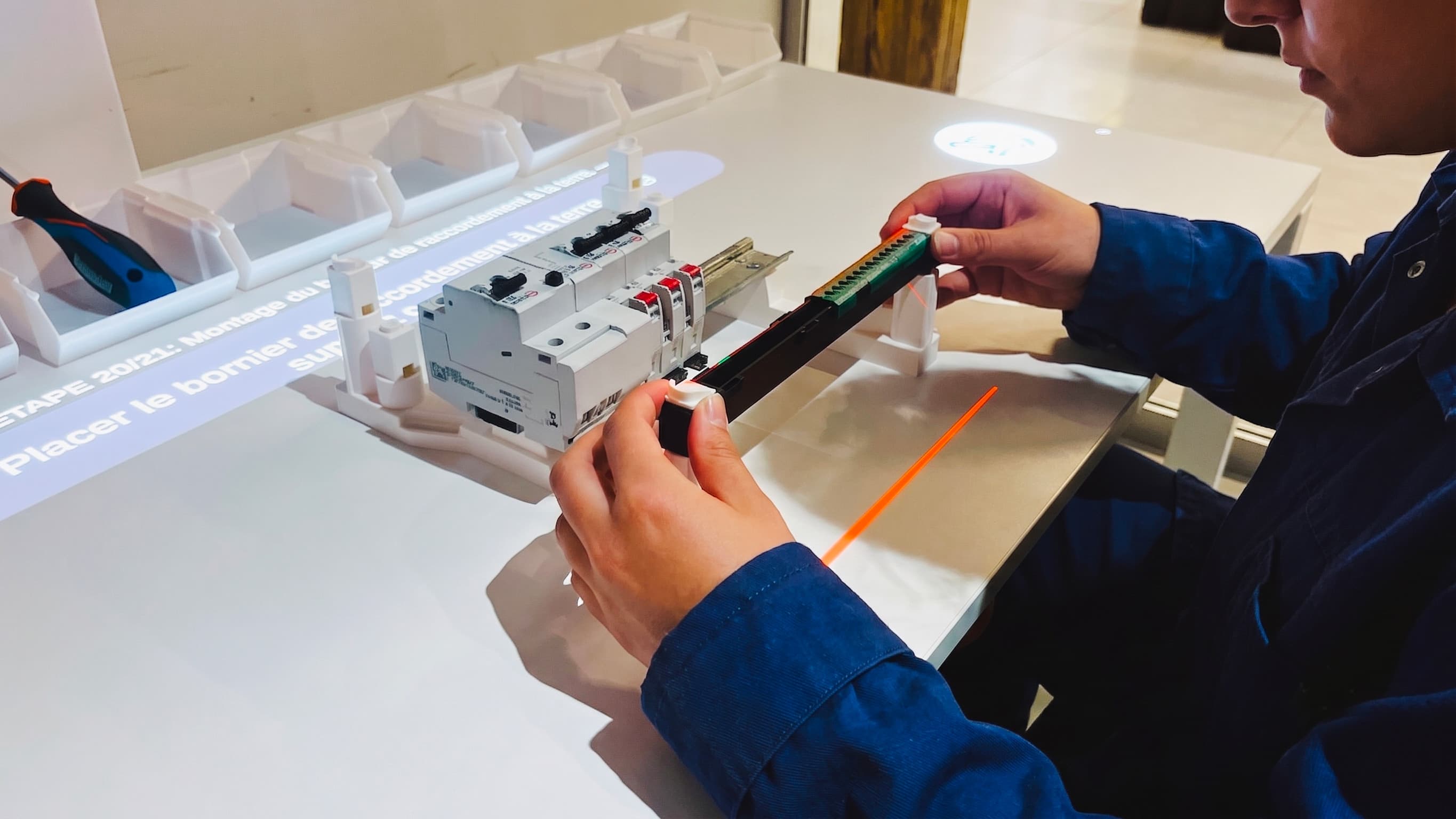
Instructions, zones and visual guidance appear directly on the work surface, without headsets or individual screens.
Computer vision
The camera understands context: object placement, gesture progress, participant presence and step validation.
AI assistance
Procedures, supporting content and summaries can be generated or adapted from documents, videos and field feedback.
From business content
to field action
CARDS connects activity preparation, projection in the physical workspace and result capture in one flow.
Prepare
Create or adapt scenarios, instructions, quality checks and collaborative activities from the platform.
Project
Display instructions close to the action: parts, tools, circulation areas, tables or training supports.
Interact
Manipulate physical objects, cards, sticky notes or parts while keeping a reliable digital trace.
Measure
Capture validations, decisions and useful data to improve procedures and future sessions.
Designed for
operational environments
The technology is built to stay robust in workshops, training rooms and collaborative spaces where teams need to act quickly.
No headset, no individual screen, no break between the real and digital workspace.
Fast setup
A compact setup that adapts to existing spaces and avoids heavy integrations.
Tangible interaction
Users work with their hands, their parts and their usual physical supports.
Reliable guidance
Projected sequences standardize gestures, reduce omissions and support quality.
No-code creation
Operational teams can evolve content without waiting for dedicated development.
A technology designed to be understood, adopted and measured.
30 min
to deploy a first on-site experience
0 headset
to keep teams in their natural environment
100%
adaptable to industry, training and safety use cases
Trusted by






Discover CARDS
FAQ
CARDS is a deeptech spatial augmented reality solution designed primarily for fixed workstations. A projector displays information at the point of action, while one or more sensors observe the relevant areas of the workstation. The product combines three building blocks: • spatial projection that displays instructions, markers, arrows, images or videos directly on the work surface, part or tooling; • workstation perception that can detect markers, areas, the presence of objects or certain events, depending on the scenario and the validated level of robustness; • CARDS Studio and an AI pipeline that help turn a demonstration, video, audio recording or document into a structured procedure, always reviewed and approved by operational teams. Operators work without a headset or separate screen. The most advanced automated features, such as fine-grained gesture recognition and generalization to new workstations, are being progressively industrialized and validated for each use case.
For a standard configuration, CARDS targets a complete installation in under an hour, including guided calibration in under ten minutes. A simple demonstration can be set up faster. Moving into production also includes mounting, checking lighting and the field of view, operational validation of the procedure and a workstation trial. Any quoted lead time therefore remains tied to a precise scope.
CARDS is designed to run already-published procedures locally. Full offline operation, deferred synchronization and local execution of all AI models are currently being industrialized. For a standalone demonstrator, IT department involvement can remain limited. It becomes necessary whenever a project involves accounts, network traffic, a defined hosting environment or integration with the information system.
CARDS is primarily intended for fixed or semi-fixed workstations in existing industrial environments. Ambient light, dust, vibration, occlusions and the projection surface are checked during scoping. Projector and sensor positioning is adjusted to the workstation. Environments with heavy dust, strong vibration or specific requirements such as ATEX require an assessment and, where applicable, dedicated protection; they are not assumed to be compatible by default.
Depending on the scenario, sensors process markers, object positions, step confirmations and events relevant to the procedure. Only people authorized by the client can access retained data. CARDS does not use facial recognition in its intended operation, and the camera is framed around the work area. A demonstration video may be captured when an expert starts creating a procedure; its retention, recipients and deletion are then defined with the client.
Yes. Authorized teams can create and edit scenarios, instructions, checks and activities in CARDS Studio without custom development for standard uses. AI proposes an initial structure from a demonstration, video, audio recording or document. An expert or methods manager always reviews, corrects and approves the procedure before publication. Automation speeds up formalization; it does not replace operational expertise.
A change follows a simple cycle: editing, operational review, approval and publication. The relevant workstations receive the new version on publication or during their next synchronization. Configured validations and feedback can then inform the next review. Versioning, approval and rollback rules are defined with the client and reinforced as the product is industrialized.
CARDS avoids individual equipment that must be worn, charged or disinfected. Instructions appear in the shared space, as close as possible to the part, and adoption remains quick. Augmented reality headsets are relevant for mobile operations, remote assistance or some 3D content; tablets remain useful for consulting and completing detailed records. CARDS is particularly suited to fixed, collaborative workstations and operations that require a precise marker at the point of action.
CARDS addresses five main families of use cases: knowledge transfer and workforce upskilling; assembly or maintenance guidance; quality control and rework; safety onboarding and prevention; and lessons learned and continuous improvement. The technology provides the most value for complex, variable or critical manual operations within existing industrial workstations. Deployment generally starts with a four- to six-week pilot focused on no more than three indicators before replication to other workstations or sites is considered.
Want to see the technology in real conditions?
We can show you how CARDS transforms a workstation, table or room into an augmented workspace.
Request a demo